
Brazed plate heat exchangers for Data Centers
The thermal interface between the IT circuit and the facility circuit: CDUs, liquid cooling and heat recovery.
Davhex supplies CDU manufacturers and designers of liquid-cooled data centers with brazed plate heat exchangers sized for tight approach temperatures and low pressure drops. Design and production entirely in Italy, with the production capacity to respond right away.
→ Applications in this area
Cooling digital power, from the rack to the district.
Two applications where the brazed plate heat exchanger is the thermal interface of a liquid-cooled data center.

CDU
Brazed plate heat exchangers for in-rack and perimeter CDUs, sized for tight approach temperatures and low pressure drop, keeping the IT circuit separate from the facility water.
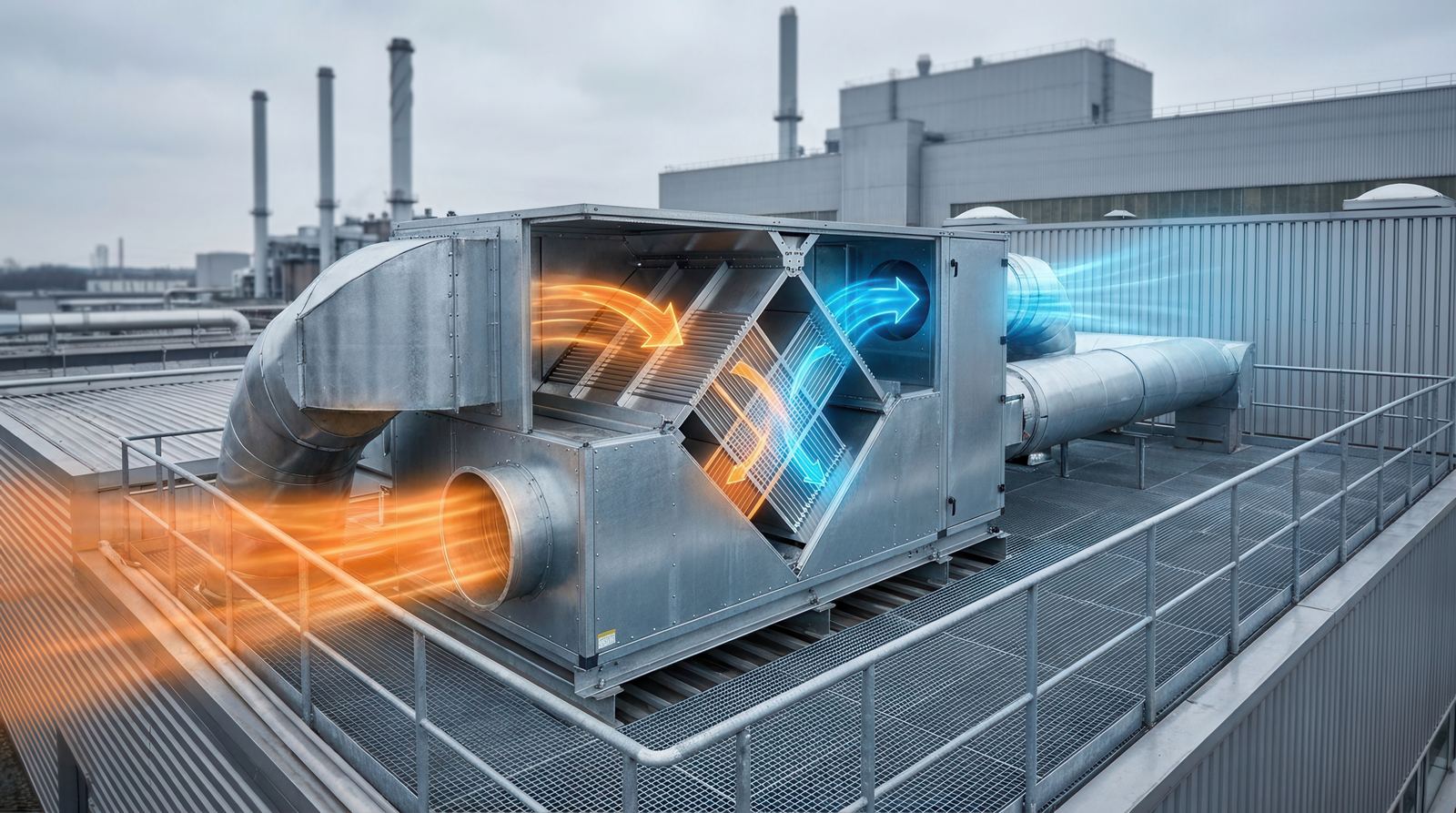
Heat Recovery
Exchangers that pass data center waste heat to district heating, hot water and low-temperature processes, with geometries optimized for small temperature differences.
→ System overview
Follow the heat, from rack to facility.
In liquid cooling, brazed plate heat exchangers appear at several points of the system: in the CDU, in heat recovery, in free cooling, in the chiller and in the transfer station to the district heating network. Each position performs a different function along the path of the thermal energy.
Simplified diagram. TCS (Technology Cooling System): the closed loop between the CDU and the IT racks. FWS (Facility Water System): the facility loop that carries the heat in series through heat recovery, free cooling and the chiller, and returns cooled to the CDU.
→ Production capacity and interchangeability
Reliable lead times, flexible quantities, samples on request.
In a sector that is growing faster than its supply chain, availability matters as much as the datasheet. Our production is now entirely in Italy, with available capacity and short lead times — for both series production and samples, so you can validate quickly.
Producing and shipping now
Available production capacity to take on new orders with no waiting list.
Reliable delivery dates
A date committed in the quotation that you can plan your production around.
Small and large orders
A dedicated small-batch line works alongside series production.
Solutions built on your design
Custom variants when your unit’s layout requires it.
Samples on request
Test it on your unit before moving to production.
→ Same footprint
Change supplier, not your unit.
Model AB is designed with a footprint and connections matched to the most common formats on the market, and fits 4U in-rack CDUs: same space, same connections, no changes to piping or brackets — a decisive advantage when your unit is already qualified. Dimensional interchangeability only: performance is verified for each duty.
Model AB
Compact 4U format with a footprint aligned with market standards and asymmetric channels for unbalanced flows.
Model F
1¼″ connections, for perimeter and mid-to-high power CDUs. Compatibility checked case by case.
→ Check interchangeability
Looking for an alternative to your current supplier?
Tell us the manufacturer, model and plate count of the heat exchanger you use today: we’ll check dimensional compatibility and propose the Davhex equivalent.
→ The role of the BPHE
One component, four critical positions.
The BPHE is where the technology circuit (TCS) and the facility circuit (FWS) exchange energy while remaining hydraulically independent. Its efficiency determines how high the facility water temperature can rise — and therefore how many hours a year you can run on free cooling.
| Function | Where | Design criticality |
|---|---|---|
| TCS–FWS interface | Liquid-to-liquid CDU | Separates the fluid in contact with the electronics from the facility water and confines any leak to a single circuit |
| In-rack CDU | 50 – 300 kW | The rack-unit footprint is the constraint: the pump is small and the Δp budget is tight |
| Perimeter CDU | 300 – 500 kW | Here approach temperature and pressure drop rule, not space |
| Heat recovery | District heating, DHW, process | Operating at low LMTD: the condition where plate technology has its clearest advantage |
→ Range coverage
From the rack to the plant room.
From 4U units to perimeter CDUs up to 500 kW: whatever the power density of your project, the range has a configuration to cover it.
| Parameter | Davhex range | Note |
|---|---|---|
| Power per unit | 3 – 500 kW | From in-rack units to perimeter CDUs |
| Approach temperature | 2 – 5 K | The dominant parameter: every kelvin gained means more hours of free cooling |
| Pressure drop | < 35 kPa in-rack · < 50 kPa perimeter | Typical design values, per side. Affects pump consumption, and therefore PUE |
| Number of plates | Up to 300 | Depending on the model |
| Connections | 20 mm – 2½″ | From compact formats to high flow rates |
| Fluids | Depending on the project | Compatibility verified case by case |
→ The Davhex solution
The right geometry for every specification.
Maximizing efficiency at low approach and keeping pressure drop under control are competing goals: the balance lies in the plate geometry. That’s why every heat exchanger is configured on your operating point, not picked from a catalog on kW alone.

High Heat Transfer
High chevron angle. More turbulence, higher heat transfer coefficient. The right choice when the required approach drops below 3 K, and for heat recovery at tight LMTD.

Low Pressure Drop
Low chevron angle. Reduces pressure drop. Preferable in in-rack units, where the pump is small by definition, or with high glycol concentrations.

Mixed Geometry
Mixed H/L plates and asymmetric channels. They fine-tune the trade-off, or handle unbalanced flows between primary and secondary, without changing size.
→ The Polidoro advantage
Short qualification times. Continuous supply.
CDU manufacturers work on compressed development cycles and fast-growing volumes. Davhex is part of an industrial group that has been making thermal components for eighty years, with R&D and production in the same plant: prototyping and production ramp-up follow the same path, with no hand-offs between suppliers. And when recovered heat ends up in a district heating network, we know those systems from the generation side too.
80
years of thermal components
Made in Italy
Designed in our Schio headquarters
Available
production capacity
In-house R&D center
CFD simulation and thermal validation
Dedicated test rooms
Performance and life testing
OEM co-development
Custom variants, European supply chain
Tell us about your project
Working on a liquid cooling project?
Tell us what you’re working on — heat load, IT-circuit and facility temperatures, fluids, available pressure drop: one of our engineers will reply with a sized proposal.
Parameters to share